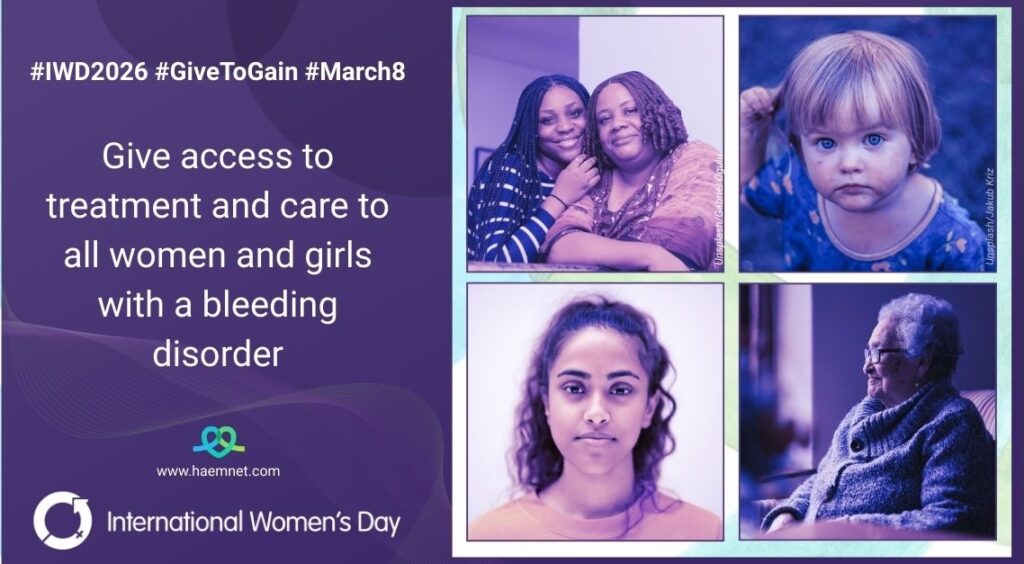
Give care to women and girls with bleeding disorders: International Women’s Day 2026
March 8, 2026, is the 115th International Women’s Day. First marked in 1911, as well as celebrating women’s social, economic, cultural and political achievements, its purpose is to advance gender equality in all aspects of life.
We wondered how 115 years of International Women’s Day compares with our knowledge of bleeding disorders. And what do we know today about how well women and girls affected by bleeding disorders are treated and cared for?
A brief history of bleeding disorders
The first written reference to an individual with a tendency to bleed dates back to the Talmud, around 200 AD, but it’s not until the early 19th century that we start to learn more about haemophilia. In 1803, American physician John C. Otto identified a bleeding disorder that appeared to affect only male males. He noted: “It is a surprising circumstance that the males only are subject to this strange affection.” He also noted: “Although females are exempt, they are still capable of transmitting it to their male children.”
A decade later, John Hay’s 1813 account of a bleeding disorder in the Appleton family helped identify that men with haemophilia passed the trait on to daughters who appeared otherwise unaffected. The term ‘haemophilia’ was first used in 1828.
Glanzmann thrombasthenia was first described in 1918, and Factor I (fibrinogen) deficiency in 1920. In 1926, Erik von Willebrand published findings about the bleeding disorder that would take his name. The 1940s saw the identification of deficiencies in Factor II and Factor V, and Bernard-Soulier Syndrome. Further factor deficiencies were identified in the 1950s (Factors VII, X, XI and XII) and 1960s (Factor XIII), and in 1952 Haemophilia B was identified as distinct from Haemophilia A.
Visible but invisible
In short, International Women’s Day – and efforts to promote gender equality in modern times – is older than most of our knowledge about bleeding disorders.
That said, we have known for some time that women and girls are affected by bleeding disorders. Erik von Willebrand described the condition he identified as affecting males and females. Factor V deficiency was first identified in a three-year-old girl. The inheritance patterns of different bleeding disorders were known – and they showed that women could be affected.
So, why are we still struggling to ensure that they have the treatment and care they need?
Heard but not seen
Earlier this year, the World Federation of Hemophilia (WFH) National Member Organization (NMO) survey on women and girls with bleeding disorders was published. It noted “under-recognition” and “under-reporting”, delays in diagnosis and its associated negative impacts on health and quality of life, and barriers to accessing care and treatment.
Globally, only 1.22% of the NMOs who responded said that women and girls had access to specialised clinics in treatment centres countrywide.
Challenges in addressing the needs of women and girls with bleeding disorders included lack of understanding among healthcare professionals, women themselves, and the wider public.
Cultural and social barriers were among the greatest challenges – including persistence of the view that women are primarily ‘carriers’ and caregivers, rather than individuals who are affected and impacted by a bleeding disorder.
Still a Cinderella story?
Sadly, these findings aren’t entirely unfamiliar to Haemnet. They echo what we found in the Cinderella Study (2020-2022), which heard from almost 300 women in the UK bleeding disorder community.
The Cinderella Study concluded that “Many of the experiences described by women with bleeding disorders 20 years ago remain prevalent,” and called for better treatment and support.
There have been some positive developments, for example the development of European Principles of Care for Women and Girls with Bleeding Disorders, and changes in nomenclature to support better understanding of the status of women impacted by haemophilia. But there is still a long, long way to go.
For International Women’s Day 2026, we hope to give visibility and a voice to women and girls affected by bleeding disorders.
Because isn’t it time that everyone was given access to the treatment and care they need?
Further information
Publications from the Cinderella Study include:
- Sanigorska A, et al. The lived experience of women with a bleeding disorder: A systematic review. Res Pract Thromb Haemost 2022; 6(1). doi: 10.1002/rth2.12652
- Khair K, et al. The views of women with bleeding disorders: Results from the Cinderella study. Haemophilia 2022; 28(2). doi: 10.1111/hae.14514
Short animations based on the real-life stories of women who participated in the Cinderella Study are available on our YouTube channel
About the author
Kathryn Jenner is Communications and Community Manager at Haemnet Ltd.